The bioavailability of minerals in supplements varies significantly based on their chemical form, considerably impacting their therapeutic efficacy. This blog post examines the current scientific understanding of which magnesium, iron, copper, zinc, and selenium forms demonstrate superior bioavailability in dietary supplements.
Magnesium Bioavailability in Supplements

Magnesium supplements are available in numerous chemical forms, each with distinct absorption profiles. Among these, magnesium di-glycinate (bis-glycinate) demonstrates the highest bioavailability. Research has consistently shown that magnesium di-glycinate is more easily absorbed and transported to the bloodstream than other common forms. When compared directly with magnesium oxide and magnesium citrate, magnesium di-glycinate consistently outperforms both in absorption efficiency1.
Magnesium citrate holds an intermediate position in the bioavailability hierarchy. Studies show that magnesium citrate has statistically higher bioavailability when compared to magnesium oxide, making it a better choice for those seeking improved absorption2. However, it doesn’t match the superior absorption profile of magnesium di-glycinate.
Magnesium citrate holds an intermediate position in the bioavailability hierarchy. Studies show that magnesium citrate has statistically higher bioavailability when compared to magnesium oxide, making it a better choice for those seeking improved absorption2. However, it doesn’t match the superior absorption profile of magnesium di-glycinate.
Despite often providing a high level of elemental magnesium (making it look impressive on supplement labels), magnesium oxide demonstrates limited bioavailability. In comparative studies of magnesium supplement bioavailability, magnesium oxide consistently performed the worst3. Additionally, magnesium oxide may lead to digestive discomfort, including diarrhoea, due to its low absorption rate in the intestine, as it’s commonly used for its laxative effects4.
A comprehensive investigation of 15 magnesium products showed wide variation in absorption and dissolution rates. Importantly, poor bioaccessibility observed in vitro directly translated to poor bioavailability in vivo, confirming that the form of magnesium significantly impacts its utilization by the body5.
Iron Supplement Bioavailability
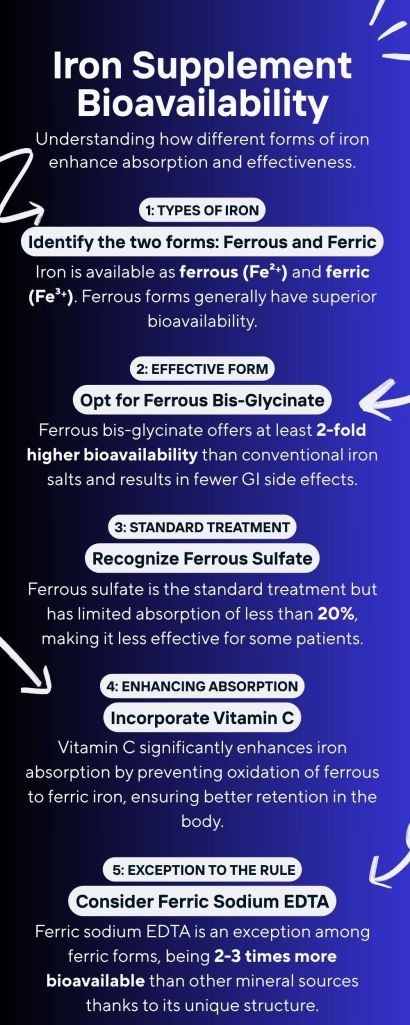
Iron supplements are predominantly available in two primary chemical states: ferrous (Fe²⁺) and ferric (Fe³⁺) forms. Current evidence supports that ferrous forms generally demonstrate superior bioavailability compared to most ferric preparations, as ferrous iron (Fe²⁺) is the only form that can be absorbed through iron transporters of intestinal enterocyte cells 6,7.
Among ferrous preparations, ferrous bis-glycinate has emerged as a particularly effective option. Scientific studies confirm it is “an amino acid iron chelate that has at least 2-fold higher bioavailability than conventional iron salts and has been associated with fewer adverse GI side effects”. The molecular structure contributes to this enhanced absorption, as “ferrous bis-glycinate chelate is a highly stable compound composed of 2 glycine molecules bound to a ferrous cation by covalent and coordinate covalent bonds”8.
Despite its limitations, ferrous sulfate has long been the reference standard for iron supplementation. Current data show that “slow-release ferrous sulphate preparations remain the established and standard treatment of iron deficiency, irrespective of the indication”6. However, its absorption efficiency is limited, with research indicating that “iron bioavailability from inorganic salts is low; <20% is typically absorbed in the duodenum, and the remaining iron passes unabsorbed into the colon” 8.
Scientific evidence strongly supports the significant enhancement of iron absorption by vitamin C. Research confirms that “vitamin C can create a more acidic environment in the stomach and prevent the oxidization of ferrous iron to ferric iron” 9.
While ferric forms generally show lower bioavailability than ferrous preparations, ferric sodium EDTA represents a notable exception. The European Food Safety Authority (EFSA) confirms that “iron from ferric sodium EDTA is 2 to 3 times more bioavailable than other mineral sources”10. This enhanced absorption is due to its unique chemical structure, as it is “a complex between ferric ion and ethylenediaminetetraacetate that provides a highly bioavailable and stable source of iron that can cross through the stomach without modification and to release ferric ion in the duodenal tract where it can be easily absorbed”11.
Copper Forms and Their Absorption

While research into copper supplement bioavailability is less extensive than other minerals, available evidence suggests significant differences between forms. Copper bis-glycinate has significantly higher bioavailability than other copper forms commonly used in supplements12.
Copper citrate represents the most common type of dietary copper in supplements due to its lower cost and widespread availability. However, there are legitimate concerns about its relatively limited bioavailability. In contrast, copper bis-glycinate, which is bonded to a glycerin substrate, absorbs directly into the bloodstream. This direct absorption pathway contributes to copper bis-glycinate’s superior bioavailability compared to copper citrate.
It’s worth noting that research into different types of copper supplements remains in its relative infancy. Regulatory agencies, including the European Food Safety Authority (EFSA) and the American Office of Dietary Supplements, acknowledge the importance of copper in human nutrition but have not yet provided concrete data on the bioavailability differences between various copper forms 13,14.
Zinc Supplement Bioavailability
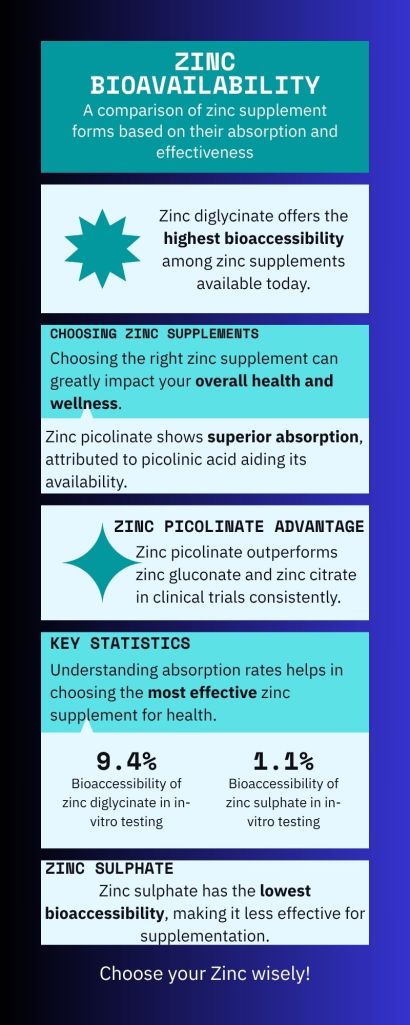
Zinc supplement bioavailability varies significantly between different chemical forms. Current research suggests that zinc diglycinate demonstrates the highest bioaccessibility among zinc supplements, with rates reaching up to 9.4% in in-vitro testing. At the opposite end of the spectrum, zinc sulphate showed the lowest bioaccessibility at just 1.1% 15.
Zinc picolinate also demonstrates excellent bioavailability. A double-blind, placebo-controlled cross-over trial found that zinc picolinate was absorbed significantly better than both zinc gluconate and zinc citrate. After four weeks of supplementation with zinc picolinate, researchers observed significant increases in zinc levels in hair, urine, and erythrocytes, while no significant changes were noted with zinc gluconate or zinc citrate supplementation16.
The superior absorption of zinc picolinate may be related to picolinic acid, a natural product of normal tryptophan metabolism in the body that appears to be an important component of zinc absorption. Unlike many other mineral chelates, using exogenous zinc picolinate may actually provide the compound usually created by the body in the intestinal tract to facilitate zinc absorption 17.
Selenium Forms and Absorption Profiles

Selenium bioavailability varies significantly between organic and inorganic forms. Organic selenium, particularly selenomethionine (SeMet), demonstrates substantially higher bioavailability than inorganic forms like sodium selenite 18,19.
Studies indicate that approximately 80% of selenomethionine is absorbed in the intestine, compared to only about 40% of selenite19. This significant difference in absorption efficiency makes organic selenium forms generally preferable in supplementation contexts. Additionally, organic selenium demonstrates higher retention in the body and lower toxicity profiles compared to inorganic forms18.
In foods, selenium naturally occurs primarily as selenomethionine and selenocysteine, and the body readily absorbs dietary selenium in these forms. When comparing selenium supplements directly, selenomethionine has been shown to be more effective than sodium selenite in clinical applications such as lowering thyroid peroxidase antibodies, with researchers attributing this enhanced efficacy to selenomethionine’s superior absorption20.
The collective evidence strongly suggests that organic selenium forms, particularly selenomethionine, represent the optimal choice for selenium supplementation based on their bioavailability, retention, and safety profiles18,21.
Conclusion
When selecting mineral supplements, the chemical form significantly impacts bioavailability and therapeutic effectiveness. Based on current scientific evidence, the forms with the highest bioavailability for each mineral are:
- Magnesium diglycinate (bis-glycinate) demonstrates superior absorption compared to other forms, with magnesium citrate offering a moderately bioavailable alternative.
- Scientific evidence shows notable differences in the bioavailability of iron supplements. Ferrous bis-glycinate has superior bioavailability, with at least double the absorption efficiency of traditional iron salts. Ferric sodium EDTA is also noteworthy, offering 2-3 times higher bioavailability than other mineral sources. Adding vitamin C enhances absorption by keeping iron in the ferrous state and forming soluble complexes. Liquid formulations typically have better bioavailability than solid forms, bypassing the dissolution step required for tablets.
- Copper bis-glycinate appears to have superior bioavailability compared to copper citrate, though research in this area remains limited.
- Zinc diglycinate shows the highest bioaccessibility in recent studies, with zinc picolinate also demonstrating excellent bioavailability and proven efficacy in clinical applications.
- Organic selenium forms, particularly selenomethionine (SeMet), demonstrate significantly higher bioavailability, better retention, and lower toxicity than inorganic forms like sodium selenite.
These findings provide valuable guidance for healthcare practitioners and consumers seeking to optimize mineral supplementation strategies for improved therapeutic outcomes.
Make a one-time donation
Make a monthly donation
Make a yearly donation
Choose an amount
Or enter a custom amount
What If Your Donation Could Change Everything?
Let’s be honest: most people scroll past donation buttons. But you’re not most people.
You’re here because you care about knowledge, about real stories, about making a difference for people who need it most. You know that every breakthrough, every recipe, every insight on raremetabolicinsights.com is a lifeline for someone out there.
Here’s the truth:
This site isn’t powered by big sponsors or faceless corporations. It’s powered by people like you—people who believe that sharing knowledge can change lives.
Why Donate?
Every euro you give is a vote for more content, more recipes, more hope.
Your support means we can publish more often, dive deeper, and reach more families who need answers.
You’re not just donating—you’re joining a movement that refuses to let rare conditions mean rare support.
Imagine This:
Tomorrow, someone finds a recipe here that finally makes their child’s diet easier. Next week, a parent reads a guide that gives them hope. That’s the impact you can have—right now.
If you’ve ever found value here, pay it forward.
Your donation—no matter the size—keeps this community alive and growing.
“The only thing standing between someone and the life-changing information they need… is whether we show up for each other.”
What If Your Donation Could Change Everything?
Let’s be honest: most people scroll past donation buttons. But you’re not most people.
You’re here because you care about knowledge, about real stories, about making a difference for people who need it most. You know that every breakthrough, every recipe, every insight on raremetabolicinsights.com is a lifeline for someone out there.
Here’s the truth:
This site isn’t powered by big sponsors or faceless corporations. It’s powered by people like you—people who believe that sharing knowledge can change lives.
Why Donate?
Every euro you give is a vote for more content, more recipes, more hope.
Your support means we can publish more often, dive deeper, and reach more families who need answers.
You’re not just donating—you’re joining a movement that refuses to let rare conditions mean rare support.
Imagine This:
Tomorrow, someone finds a recipe here that finally makes their child’s diet easier. Next week, a parent reads a guide that gives them hope. That’s the impact you can have—right now.
If you’ve ever found value here, pay it forward.
Your donation—no matter the size—keeps this community alive and growing.
“The only thing standing between someone and the life-changing information they need… is whether we show up for each other.”
What If Your Donation Could Change Everything?
Let’s be honest: most people scroll past donation buttons. But you’re not most people.
You’re here because you care about knowledge, about real stories, about making a difference for people who need it most. You know that every breakthrough, every recipe, every insight on raremetabolicinsights.com is a lifeline for someone out there.
Here’s the truth:
This site isn’t powered by big sponsors or faceless corporations. It’s powered by people like you—people who believe that sharing knowledge can change lives.
Why Donate?
Every euro you give is a vote for more content, more recipes, more hope.
Your support means we can publish more often, dive deeper, and reach more families who need answers.
You’re not just donating—you’re joining a movement that refuses to let rare conditions mean rare support.
Imagine This:
Tomorrow, someone finds a recipe here that finally makes their child’s diet easier. Next week, a parent reads a guide that gives them hope. That’s the impact you can have—right now.
If you’ve ever found value here, pay it forward.
Your donation—no matter the size—keeps this community alive and growing.
“The only thing standing between someone and the life-changing information they need… is whether we show up for each other.”
References
1. Pardo, M. R., Garicano Vilar, E., San Mauro Martín, I. & Camina Martín, M. A. Bioavailability of magnesium food supplements: A systematic review. Nutrition 89, 111294 (2021).
2. Kappeler, D. et al. Higher bioavailability of magnesium citrate as compared to magnesium oxide shown by evaluation of urinary excretion and serum levels after single-dose administration in a randomized cross-over study. BMC Nutrition 3, 7 (2017).
3. Lindberg, J. S., Zobitz, M. M., Poindexter, J. R. & Pak, C. Y. Magnesium bioavailability from magnesium citrate and magnesium oxide. J Am Coll Nutr 9, 48–55 (1990).
4. Magnesium Oxide: Benefits, Side Effects, Dosage, and Interactions. https://www.healthline.com/nutrition/magnesium-oxide.
5. Blancquaert, L., Vervaet, C. & Derave, W. Predicting and Testing Bioavailability of Magnesium Supplements. Nutrients 11, 1663 (2019).
6. Santiago, P. Ferrous versus Ferric Oral Iron Formulations for the Treatment of Iron Deficiency: A Clinical Overview. The Scientific World Journal 2012, 846824 (2012).
7. Piskin, E., Cianciosi, D., Gulec, S., Tomas, M. & Capanoglu, E. Iron Absorption: Factors, Limitations, and Improvement Methods. ACS Omega 7, 20441–20456 (2022).
8. Fischer, J. A. J., Cherian, A. M., Bone, J. N. & Karakochuk, C. D. The effects of oral ferrous bisglycinate supplementation on hemoglobin and ferritin concentrations in adults and children: a systematic review and meta-analysis of randomized controlled trials. Nutr Rev 81, 904–920 (2023).
9. Li, N. et al. The Efficacy and Safety of Vitamin C for Iron Supplementation in Adult Patients With Iron Deficiency Anemia. JAMA Netw Open 3, e2023644 (2020).
10. Ferric sodium EDTA added for nutritional purposes to foods for the general population and to foods for particular nutritional uses | EFSA. https://www.efsa.europa.eu/en/efsajournal/pub/1414 (2010).
11. Giliberti, A. et al. Comparison of Ferric Sodium EDTA in Combination with Vitamin C, Folic Acid, Copper Gluconate, Zinc Gluconate, and Selenomethionine as Therapeutic Option for Chronic Kidney Disease Patients with Improvement in Inflammatory Status. Nutrients 14, 2116 (2022).
12. Hansen, S. L., Schlegel, P., Legleiter, L. R., Lloyd, K. E. & Spears, J. W. Bioavailability of copper from copper glycinate in steers fed high dietary sulfur and molybdenum. J Anim Sci 86, 173–179 (2008).
13. EFSA Panel on Dietetic Products, Nutrition and Allergies (NDA). Scientific Opinion on Dietary Reference Values for copper. EFSA Journal 13, 4253 (2015).
14. Myint, Z. W., Oo, T. H., Thein, K. Z., Tun, A. M. & Saeed, H. Copper deficiency anemia: review article. Ann Hematol 97, 1527–1534 (2018).
15. Ośko, J., Pierlejewska, W. & Grembecka, M. Comparison of the Potential Relative Bioaccessibility of Zinc Supplements—In Vitro Studies. Nutrients 15, 2813 (2023).
16. Barrie, S. A., Wright, J. V., Pizzorno, J. E., Kutter, E. & Barron, P. C. Comparative absorption of zinc picolinate, zinc citrate and zinc gluconate in humans. Agents Actions 21, 223–228 (1987).
17. Birdsall, T. C. Zinc Picolinate: Absorption and Supplementation. Alternative Medicine Review 1, (1996).
18. Thiry, C., Ruttens, A., De Temmerman, L., Schneider, Y.-J. & Pussemier, L. Current knowledge in species-related bioavailability of selenium in food. Food Chemistry 130, 767–784 (2012).
19. Shini, S., Sultan, A. & Bryden, W. L. Selenium Biochemistry and Bioavailability: Implications for Animal Agriculture. Agriculture 5, 1277–1288 (2015).
20. Office of Dietary Supplements – Selenium. https://ods.od.nih.gov/factsheets/Selenium-HealthProfessional/.
21. Fairweather-Tait, S. J., Collings, R. & Hurst, R. Selenium bioavailability: current knowledge and future research requirements. Am J Clin Nutr 91, 1484S-1491S (2010).
 Scientific Knowledge & Personal Nutrition Stories for Rare Metabolic Conditions
Leave a comment